How to choose between a Chestnut and a Medlar Makila?
When speaking of the traditional Makila, medlar wood undisputedly holds the throne of tradition. Wild medlar is not just the soul of this traditional Basque walking stick: it is a true botanical treasure unique in the world.
At Alberdi Makila, as handcrafted Makila makers, we have always highlighted the exceptional nature of medlar. The reason is fascinating: no other tree on the planet reacts quite like the wild medlar. When we make precise incisions into the bark while the tree is still growing alive in the forest, the wood heals by creating a relief that expands outwards. Every other tree species in the world heals inwards. This singular biological reaction, combined with the fact that the artisan crafting process begins on a living tree, makes a medlar Basque Makila an entirely irreplaceable piece.
However, in our workshop we also take great pride in crafting a model made from chestnut wood. If you are wondering why this option exists and which one is right for you, here is the history and technical differences behind both woods.
https://alberdimakila.com/en/medlar-tree-wood-basque-walking-stick/
Which is more traditional: the Medlar or Chestnut Makila?
Medlar wood is the indisputable origin and purest representation of the craft in Iparralde (the Northern French Basque Country). However, historically, wild medlar was a scarce resource and difficult to find in the forests of the South. For this reason, in Hegoalde (the Southern Spanish Basque Country), local artisans adopted chestnut wood to keep this living tradition alive.
To craft chestnut Makilas, those artisans applied the exact same ancestral technique on the living tree, but obtained a completely different finish due to the natural properties of the wood itself. Faithful to this legacy, my father decided to introduce Makila making in chestnut wood as an explicit tribute to all those master artisans who preserved the craft across our mountains.
What is the difference between Medlar and Chestnut on the living tree?
Although the artisan work begins in the forest on both living species, the final result when buying a Makila changes radically due to the botany of each wood:
-
The Medlar Reaction (unique in the world): When making incisions on the living medlar tree, its natural healing process creates bulges and raised markings that push outwards—a distinctive texture that cannot be replicated by any other wood on earth.
-
The Chestnut Reaction: When applying the same incisions to a living chestnut tree, the wood reacts like all other trees in the world: healing inwards. Once the stick is harvested, cured, and peeled, the cuts remain engraved as elegant, subtle indents carved into the wood, offering a warm and refined finish.
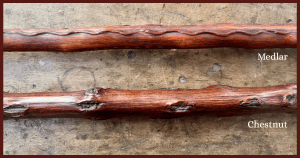
Medlar and chestnut wood
Key points to help you decide
-
Choose the Medlar Makila if: You are seeking the utmost tradition, the most iconic model, and the fascinating exclusivity of a wood whose outward-growing relief is unique in the world.
-
Choose the Chestnut Makila if: You wish to pay tribute to the artisan history of the Southern Basque territory and prefer the elegance of inward-carved patterns combined with the natural warmth of chestnut.
Both options represent absolute respect for our roots, the highest standards in metal craftsmanship (brass or nickel silver), and the dedication we pour into every piece at Alberdi Makila.
We hope learning about the botanical value and rich history of our woods helps you choose the piece that resonates most with you or the person receiving it.