“Giving a makila is telling someone how much you value them”: Interview with Beñat Alberdi in Noticias de Gipuzkoa by Anabel Dominguez
In the Alberdi workshop in Irun, every traditional Basque makila is handcrafted following an ancestral art passed down through generations. In a world that grows increasingly digital and fast-paced, there are still places where time moves differently. At 6 Deskarga Street in Irun, the Alberdi Makila workshop keeps the tradition of the Basque staff alive, preserving the essence of Basque craftsmanship.
A family legacy of three generations
Beñat Alberdi learned the craft almost by accident. At 14 or 15, he helped his father Iñaki “to earn some extra pocket money,” unaware that the gesture would shape his path. His grandfather, José Alberdi Arruti, founded the workshop in 1948, initially dedicated to furniture carving and later expanding to busts, heraldry, and other woodworks inspired by Basque motifs.
In 1980, Iñaki began working on makila making, an art that had disappeared from the southern side of the Bidasoa due to the Civil War and the subsequent dictatorship. Today, Beñat and his sister Saioa continue this legacy, being the only makers in Hegoalde who craft Basque makilas in the traditional way.
The handcrafted creation of the makila
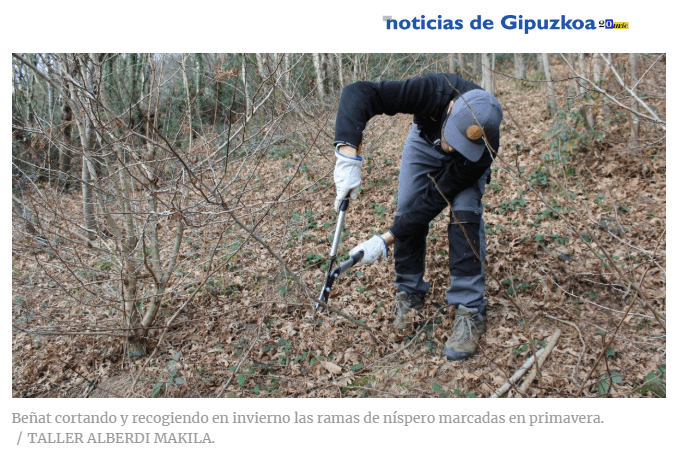
The process begins far from the workshop, in the forests where wild medlar trees grow. Selecting the tree, the branch, and the right moment for harvesting is essential. In spring, Beñat carves small incisions into the bark—a “living tattoo” that slowly heals to form the characteristic patterns of the Basque makila.
In winter, the branch is cut, oven-peeled, dyed with quicklime, and straightened with heat. The medlar wood then dries for years, sometimes up to five, with periodic checks to ensure its quality.
The lower section of the makila is covered with a brass, alpaca, or silver ferrule, hand-chiselled with Basque symbolism. The handle is crafted from horn and braided leather, incorporating the small spike once used as a defensive tool on mountain paths. Finally, personalized inscriptions are engraved on the top cap. This meticulous process makes each piece a unique work of Basque craftsmanship, rich in symbolism and tradition.
A symbol of respect and recognition
Beyond its function as a Basque walking stick, the makila is a meaningful gift. Perfect for retirements, weddings, birthdays, and other special events, each piece is tailored to the recipient’s height, weight, and personal preferences.
“Giving a makila is telling someone how much you value them,” says Beñat. A sentence that captures the essence of this tradition: a gift that conveys respect, appreciation, and affection.
The makila of honor: a legacy that crosses borders
Although its heart beats in Irun, the makilas from the Alberdi workshop have travelled worldwide—United States, Australia, England, and more. Throughout history, they have been offered to notable figures such as Pope John Paul II, kings, political leaders, chefs, artists, and athletes.
One of the most iconic pieces is the makila of honor crafted by Iñaki Alberdi for José Antonio Ardanza, a ceremonial staff inherited by every Basque premier (lehendakari) to this day. The Basque Government also commissions special makilas for official visits and institutional gifts, strengthening the makila as a symbol of prestige and tradition.
Keeping the tradition alive
For Beñat, crafting a makila is more than a profession—it is the preservation of a unique cultural heritage. Each piece reflects centuries of history, expert craftsmanship, and family dedication, keeping the essence of Basque artisan culture alive.
If you wish to learn more about our makilas or place a special order, feel free to contact us or visit our workshop in Irun. Each makila is a unique work of art that brings together history, culture, and a passion for tradition.
Full interview:
https://www.noticiasdegipuzkoa.eus/gipuzkoa/bertan/2025/11/23/regalar-makila-decirle-alguien-aprecias-10379162.html